Space Missions and Risk Management: Lessons for Companies
An analysis of risk management and transparent communication in space missions, exploring how these lessons can be applied to the corporate world through automation and artificial intelligence.


March 14, 2026
The resumption of crewed missions to the Moon, a milestone in space exploration, brings to light a fundamental discussion: risk management in complex, high-impact endeavors. Recently, a detailed analysis of the next lunar mission revealed that, despite all the planning, uncertainty persists, and transparency in communicating these risks is essential.
The new space program faces unique challenges, such as the use of relatively new technologies and the complexity of operating in a hostile environment. Clear communication about uncertainties, both internally with teams and externally with the public and authorities, is vital to maintain trust and ensure mission success.
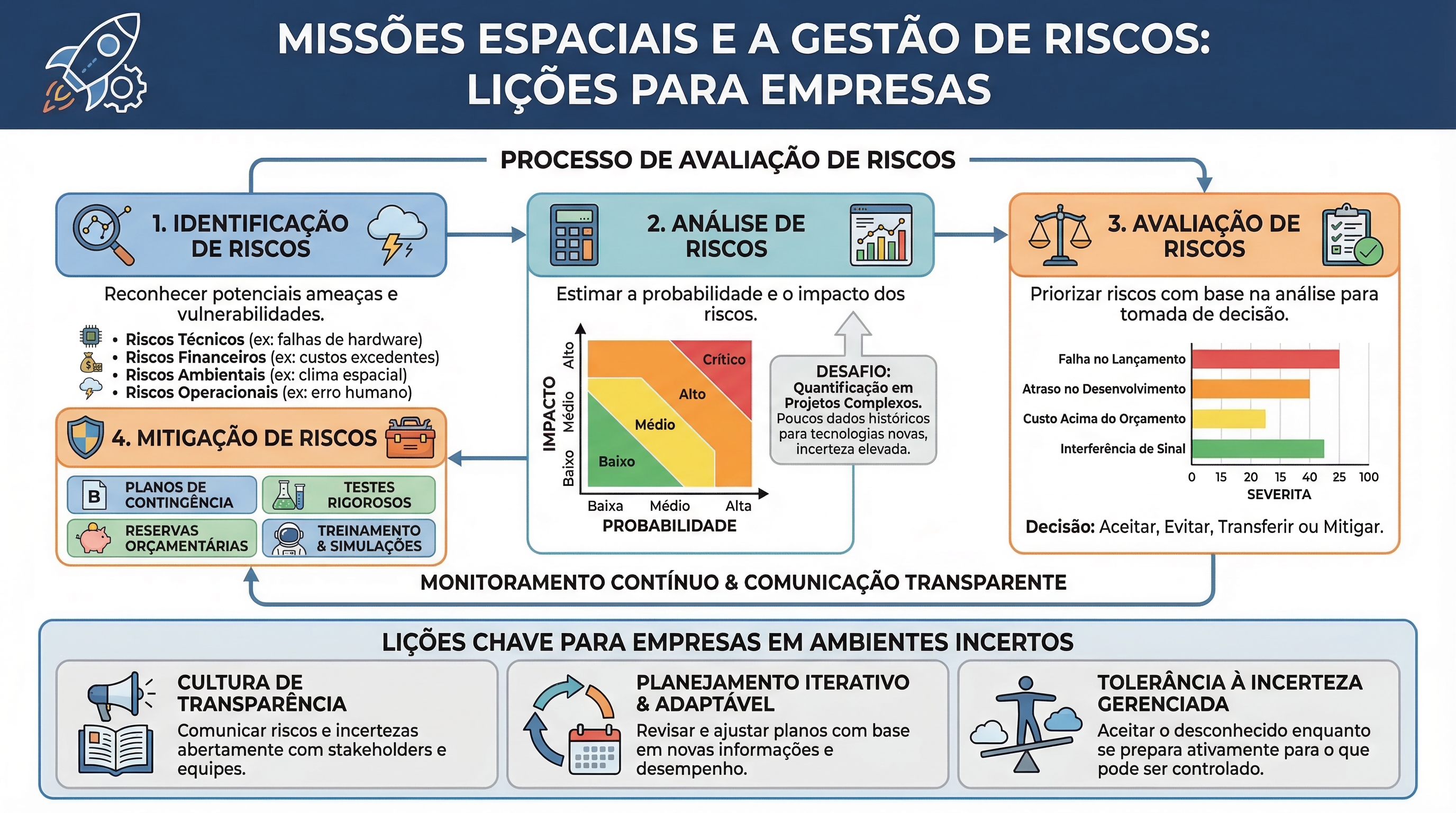
The Difficulty of Quantifying Risk
One of the greatest difficulties in risk management is quantification itself. Although it is possible to analyze the risks associated with each component and subsystem, the probability of a catastrophic event is difficult to predict accurately, especially in an environment with few historical references. Experience shows that in new projects, the failure rate on the first attempt can be as high as 50%.
This uncertainty requires a proactive approach, focused on identifying potential problems and developing contingency plans. One must be prepared for the unexpected, and the ability to adapt is fundamental to overcoming challenges.
Are you looking for tools to help identify and mitigate risks? Discover Toolzz Bots solutions and find out how automation can help you.

The Importance of Transparent Communication
Transparency in communication is crucial to ensure that everyone involved is aware of the risks and the measures taken to mitigate them. This includes the engineering team, astronauts, government authorities, and the general public. Open and honest communication helps build trust and avoid misunderstandings.
"In complex projects, communication is as important as technology," says a project management expert. "Ensuring that everyone understands the risks and responsibilities is fundamental to success."

Lessons for the Corporate World and the Role of Automation
Risk management and transparent communication are valuable lessons that can be applied to any company, regardless of sector. In an increasingly complex and dynamic business environment, it is essential to have a clear understanding of risks and opportunities.
It is in this context that automation and artificial intelligence (AI) become powerful tools. Chatbots and AI agents can be used to continuously monitor the environment, identify potential problems, and alert responsible teams. Additionally, AI can help analyze large volumes of data to identify patterns and trends that may indicate future risks.
At Toolzz, we offer customer service automation solutions with chatbots that can be integrated into your risk management systems. Our customized AI agents can assist in internal and external communication, ensuring that everyone involved is informed about risks and the measures taken to mitigate them. Our LXP platform can also be used to train teams in risk management and emergency procedures, increasing your organization's resilience. If you want to learn more about how to optimize your company's internal and external communication, explore the features of Toolzz Bots.
Next Steps
Space exploration continues to be a bold challenge, but the lessons learned along the way can be applied to various areas of life. By adopting a proactive approach to risk management and investing in technologies such as AI and automation, companies can increase their resilience, improve communication, and ensure long-term success.






















.webp)