The Future of the Salesforce Developer in the AI Era
This article explores how artificial intelligence is transforming the role of Salesforce developers, shifting the focus from implementation to system design, engineering quality, and cross-system thinking, while providing practical guidance on how to prepare for this evolution.

The Future of the Salesforce Developer in the AI Era

March 15, 2026
Artificial intelligence (AI) is transforming the software development landscape, and the Salesforce platform is no exception. Far from replacing the developer, AI is reshaping the profession, requiring new skills and a renewed focus on system design, engineering quality, and comprehensive thinking. This article explores the ongoing changes and how developers can prepare for the future.
The Evolution of the Salesforce Developer Role
For a long time, the value of a Salesforce developer resided in the ability to make the platform perform tasks that were not possible declaratively. When a Flow was not enough, a formula reached its limits, or a business requirement exceeded configuration, the developer stepped in with Apex, Lightning Web Components, and custom integrations. The core skill was implementation, transforming a requirement into a functional solution.
This era is not ending, but it is receding. Implementation skill is still important, but it is no longer the primary source of a developer's value. That source is shifting to system design, quality engineering, and cross-system thinking.
The J-Curve of AI Adoption
The adoption of AI-assisted development tools may initially decrease productivity. This does not mean the tools are bad or that you are using them incorrectly. Experience demonstrates a consistent pattern: the J-curve. To use AI effectively, it is necessary to rethink the task itself, workflows, team processes, and the way the organization builds software. This shift can generate new types of errors before delivering new levels of speed.
Ignoring this point is dangerous. It fuels the fear of low-quality code and anxiety about whether AI improves outcomes or just creates the illusion of productivity. AI is not just automating tasks, but exposing the importance of strategic system design.
The New Focus: Design, Quality, and Systemic Vision
With AI accelerating implementation, the bottleneck becomes design. Understanding what to build, why to build it that way, and how it fits into the overall system becomes crucial. AI can generate code quickly, but it cannot make complex architectural decisions or evaluate the long-term impact of different approaches. Engineering quality also becomes more important, as rigorous validation is essential to ensure that AI-generated code meets organizational standards and requirements.
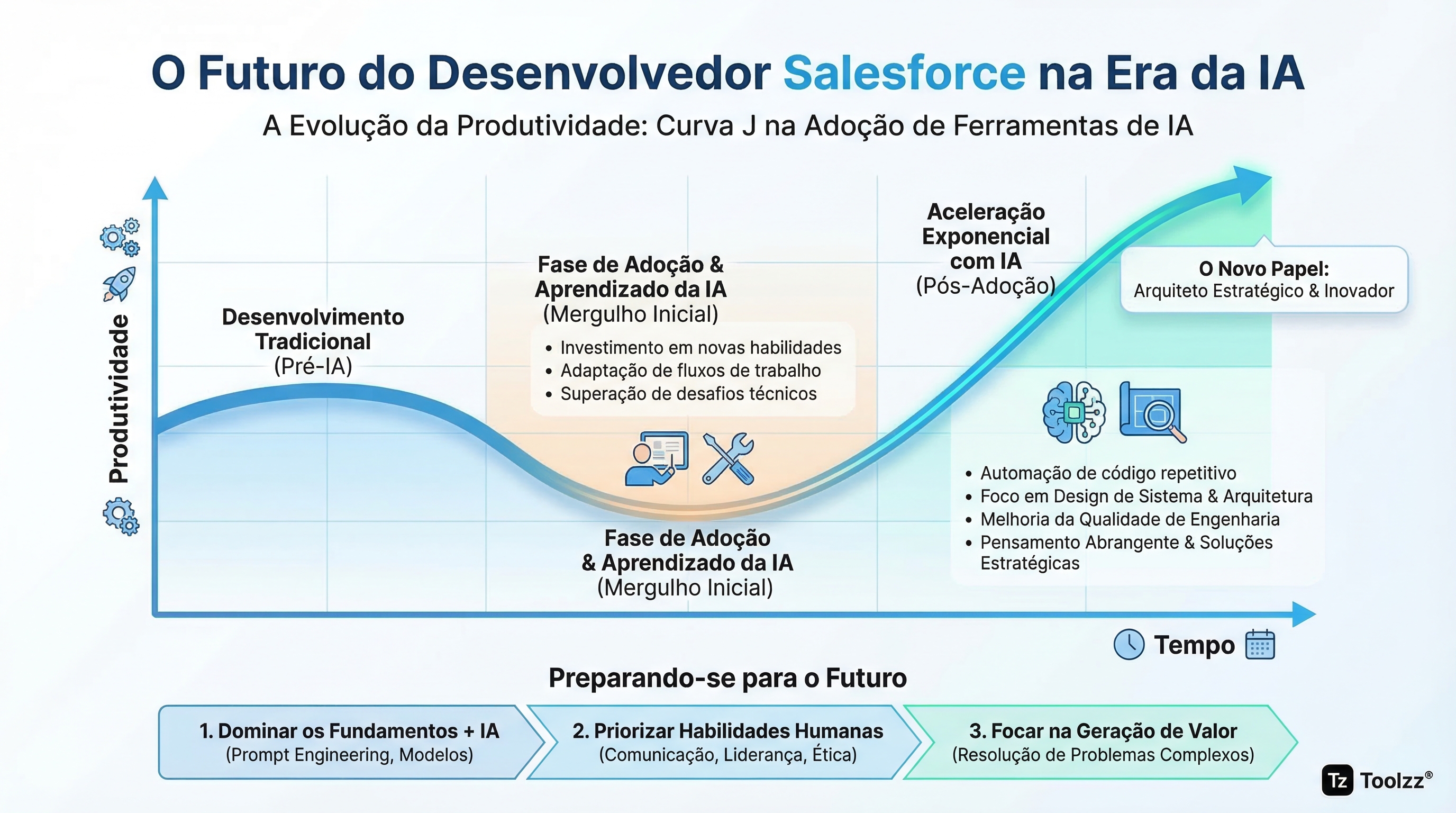
For developers, this means investing in skills such as data modeling, integration architecture, and automated testing. The ability to understand business context and translate it into effective technical solutions is also fundamental.
Ready to elevate your Salesforce skills with AI? Explore Toolzz AI plans and find the ideal solution for your team.
Challenges in Existing Salesforce Environments
Most Salesforce development projects do not start from scratch. Most developers work in complex environments, with custom objects, layered automations, and integrations with external systems. In these environments, the actual system specification resides in the code, metadata, tribal knowledge, and the team's accumulated experience. AI can analyze code structure, but it cannot access the tacit knowledge that is essential to understanding why certain decisions were made.
A practical framework for AI-assisted development in existing environments includes: mapping the current architecture, making implicit decisions explicit, and treating context as input for AI tools. By providing AI with detailed information about the environment, it is possible to improve the quality of generated code and avoid costly errors.
Essential Skills for the Developer of the Future
| Skill | What It Means | Why AI Makes It More Important | How to Start Developing |
|---|---|---|---|
| System Design | Understanding existing systems, defining architectural boundaries, and creating safeguards for AI. | AI compresses implementation, exposing design as the true bottleneck. | Map your organization's current architecture: trigger execution order, automation dependencies, integration limits, and undocumented trade-offs. |
| Quality Engineering | Treating each AI-generated artifact as a first draft, validating whether the code fits into the system, not just whether it compiles. | Rapid output increases the risk of accepting mediocre code – validation replaces generation as the central task. | Establish non-negotiable checks: passing tests, clean static analysis, complete manual review before each commit. |
| Cross-System Thinking | Seeing how your specialty connects to the broader architecture – data model, integrations, security, business logic, and user experience. | AI cannot see beyond system boundaries; developers who connect layers become indispensable. | Track a single feature end-to-end: Apex → Flow → platform event → middleware → external system → end-user impact. |
AI as a Learning Tool
AI is not just a code generation tool, but also a powerful learning tool. It allows developers to ask questions about unfamiliar codebases, explore platform behavior in real time, and get instant feedback on design decisions. This shift in the learning curve is significant, allowing developers to become more proficient at an accelerated pace.
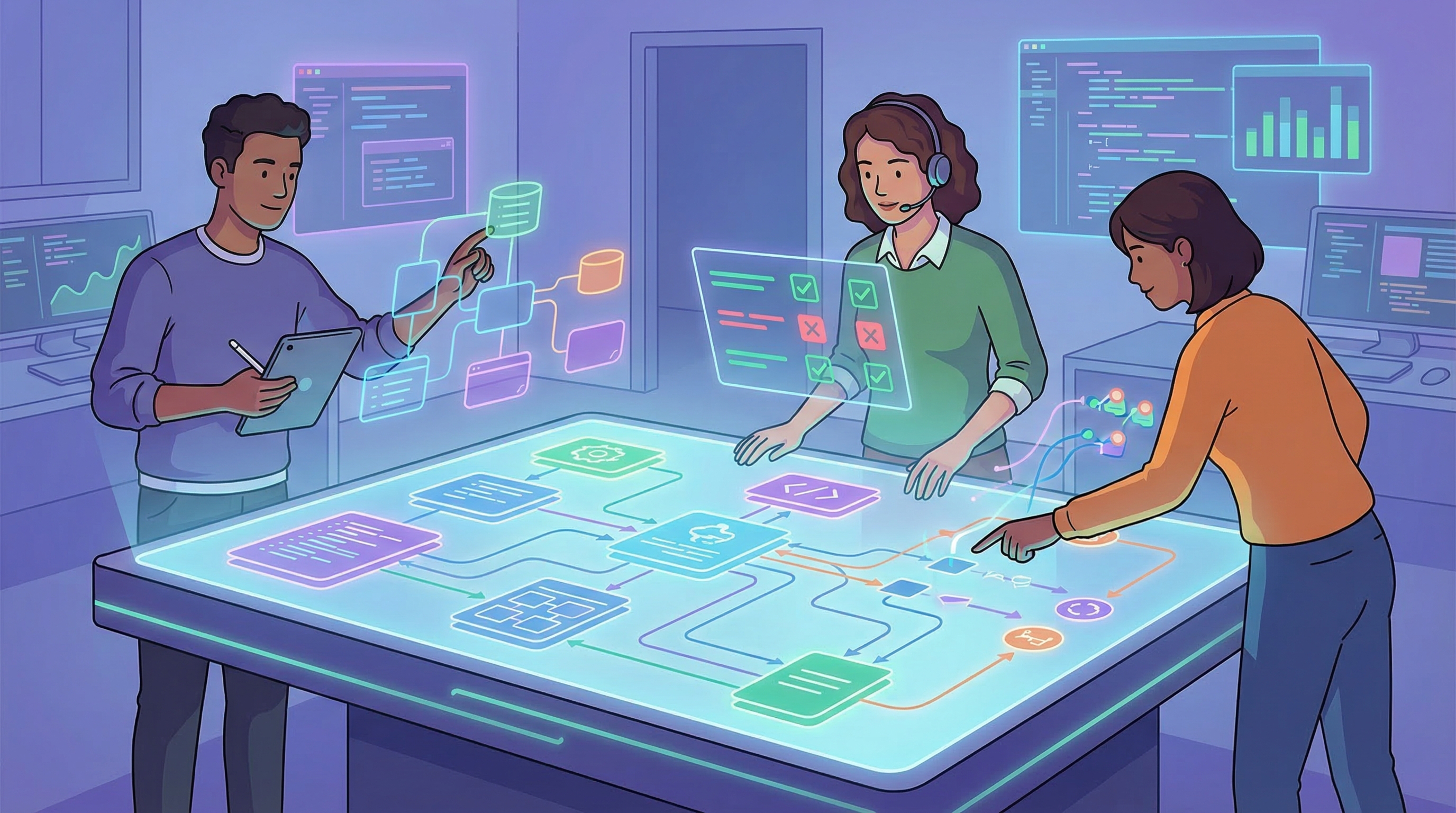
To make the most of this capability, developers should adopt a continuous learning mindset and actively experiment with new AI tools and techniques. A great way to start is to request a Toolzz AI demo and see how it can accelerate your learning and development.
Prepare for the Future with Toolzz
As the Salesforce developer role evolves, the need for tools that empower human-AI collaboration becomes increasingly important. Toolzz AI offers a powerful platform for creating custom AI agents that can automate repetitive tasks, provide valuable insights, and assist in the development process. With Toolzz AI, development teams can increase productivity, improve code quality, and focus on higher-value activities such as system design and innovation. Explore Toolzz AI and discover how it can transform the way you develop on the Salesforce platform.























.webp)