Local AI vs. APIs: Which is the Best Option for Your Business?
A comprehensive comparison between using AI APIs and local infrastructure for running AI models, exploring costs, advantages, and practical implementation strategies for businesses.

Local AI vs. APIs: Which is the Best Option for Your Business?

March 15, 2026
With the growing popularity of Artificial Intelligence, companies are constantly seeking efficient and cost-effective ways to integrate this technology into their processes. A frequent question arises: is it more advantageous to use AI APIs, such as those offered by OpenAI and Google, or to invest in local infrastructure to run models directly?
The Hidden Costs of AI APIs
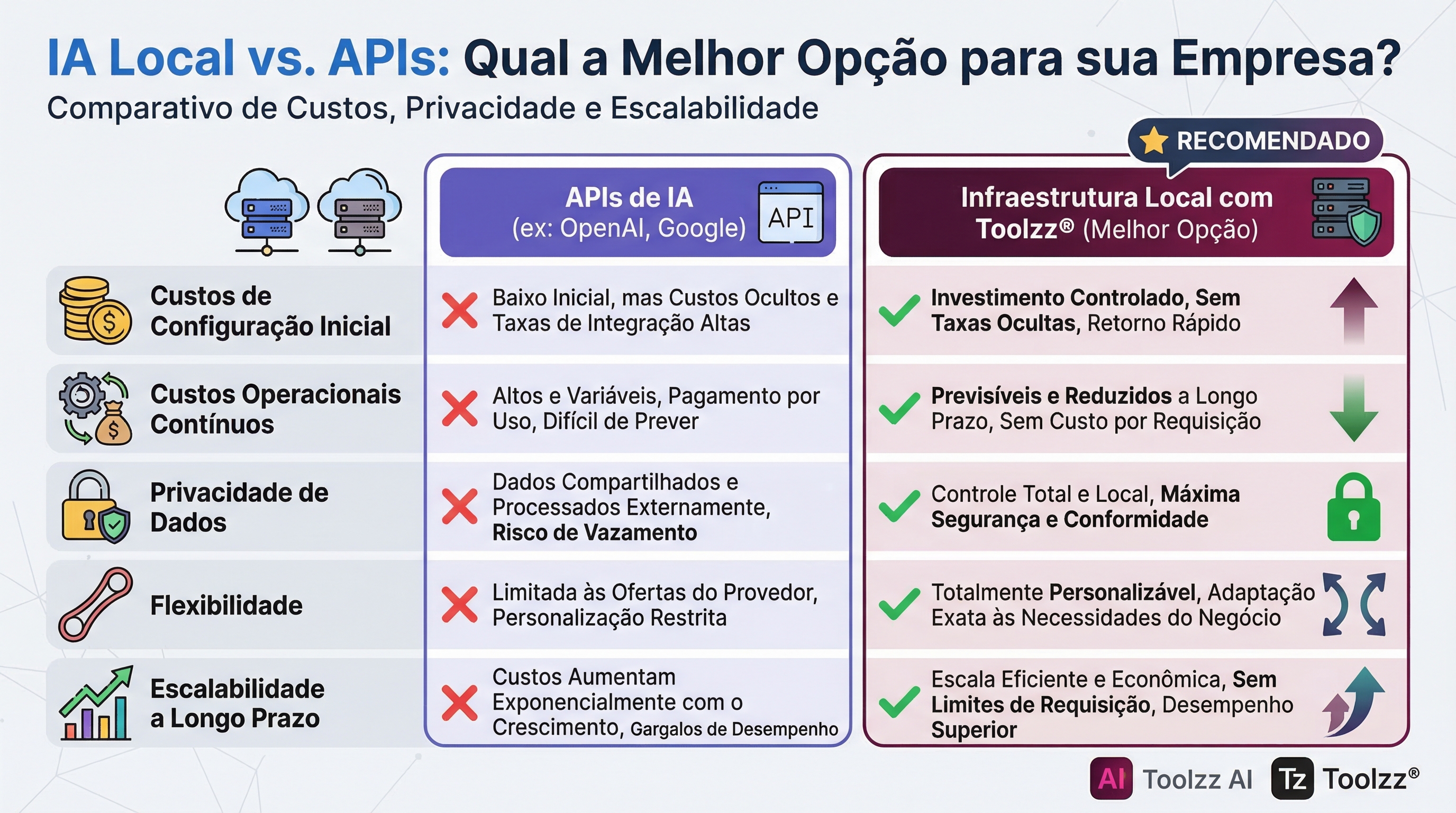
Initially, AI APIs seem like a simple and accessible solution. You pay for usage without worrying about server maintenance or the complexity of managing models. However, this convenience can come at a high cost in the long run. Each API call represents an expense, and these costs can accumulate quickly, especially in projects that require a large volume of processing or constant experimentation.
The token-based pricing model can be particularly problematic. For each test, prompt adjustment, or iteration, you need to pay, which can inhibit innovation and limit the ability to explore different approaches. Additionally, some API providers impose rate restrictions, which can interrupt workflow and compromise efficiency.
The Advantage of Local Infrastructure
Running AI models on your own infrastructure offers greater control, flexibility, and potentially long-term savings. While the initial hardware investment may be significant, operational costs are generally more predictable and can be optimized over time. Once the hardware is installed, you can run models without worrying about token fees or usage restrictions.
Furthermore, local infrastructure allows for greater data privacy and security. You have complete control over where your data is stored and processed, which is crucial for companies handling confidential information. The ability to customize and adjust models according to your specific needs is also a significant advantage.
Setting Up Your Local Environment
Setting up a local environment to run AI models may seem complex, but there are various tools and frameworks that facilitate the process. Frameworks like llama.cpp allow the execution of language models on modest hardware, paving the way for decentralized AI.
The necessary hardware varies according to the size and complexity of the models you intend to use. A dedicated GPU is essential for accelerating processing, and the amount of RAM is also an important factor. It's possible to start with a modest configuration and expand as needed.
Choosing the Right Models
When opting to run models locally, choosing the right model is crucial. There are various open-source models available, with different sizes, capabilities, and hardware requirements. Smaller models, such as those with 7B or 9B parameters, can be run on relatively modest hardware, while larger models, such as those with 70B parameters, require more resources.
It's important to carefully evaluate your project's needs and choose a model that offers the best balance between performance and efficiency. Model quantization, which reduces the size and precision of weights, can be a useful technique for optimizing performance on limited hardware.
Toolzz AI: Simplifying AI Implementation
While setting up a local environment can be challenging, Toolzz AI offers a complete solution to simplify AI implementation in your business. With Toolzz AI, you can create and customize AI agents without worrying about infrastructure complexity. The platform offers an intuitive interface and powerful tools to build agents that automate tasks, improve customer service, and drive innovation. Additionally, Toolzz AI allows integration with various data sources and existing systems, facilitating the creation of customized solutions.
Want to know more about how Toolzz AI can help you? Request a personalized demo and see it in action!
Conclusion
Running AI models locally offers greater control, flexibility, and potentially long-term savings. However, it requires an initial investment in hardware and technical expertise. AI APIs are a convenient option for smaller projects or for those seeking a quick and easy solution. The ideal choice depends on your company's specific needs, available budget, and desired level of control. Toolzz AI stands out as a platform that simplifies AI implementation, offering the best of both worlds: the flexibility of local AI and the ease of use of APIs.

























.webp)