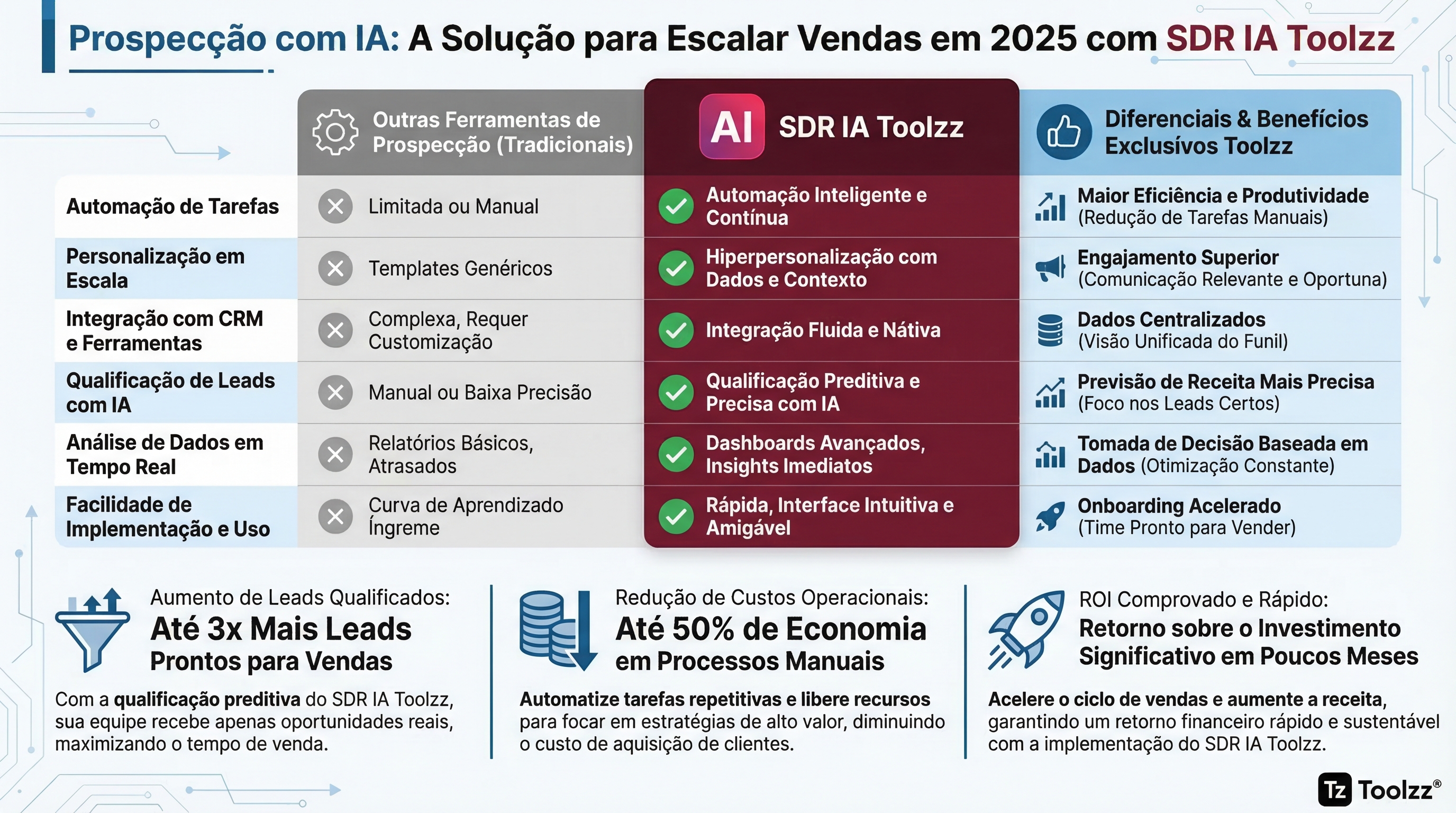
AI Prospecting is the solution to scale sales in 2025 using Toolzz AI SDR
Learn how to build a solid business case for implementing an AI SDR and calculate the ROI to justify the investment. Discover how AI automation can transform your prospecting process and boost sales results.

AI Prospecting is the solution to scale sales in 2025 using Toolzz AI SDR

March 15, 2026
In an increasingly competitive sales landscape, efficient prospecting is crucial for the success of any B2B company. Artificial Intelligence (AI) emerges as a powerful ally, automating repetitive tasks and allowing sales teams to focus on high-value opportunities. Building a solid business case for implementing an AI SDR, such as the one offered by Toolzz AI, is the first step to justify the investment and demonstrate the expected return.
1. Define Objectives and KPIs
Before diving into the numbers, it's essential to define the objectives you expect to achieve with the AI SDR. What are your prospecting team's main challenges? Increase the number of qualified leads? Reduce time spent on manual tasks? Improve conversion rate?
Define clear and measurable KPIs (Key Performance Indicators) to track progress. Some examples include:
- Number of qualified leads generated
- Lead to opportunity conversion rate
- Average lead qualification time
- Cost per qualified lead
- Return on investment (ROI)
2. Assess the Current Scenario
To calculate the AI SDR's ROI, you need a clear view of the current costs and revenues of your prospecting process. Analyze the following aspects:
- Costs: SDR team salaries, prospecting tools (LinkedIn Sales Navigator, ZoomInfo, etc.), training and development costs.
- Revenues: Average value of closed contracts, opportunity to customer conversion rate, sales cycle.
Based on this data, you'll be able to calculate the current cost per qualified lead and the time spent to convert a lead into a customer.
3. Estimate Gains with AI SDR
With Toolzz's AI SDR Agent, you can automate various stages of the prospecting process, such as:
- Identifying potential leads
- Automatic lead qualification based on predefined criteria
- Sending personalized messages via WhatsApp and other channels
- Automatic meeting scheduling
Estimate the AI SDR's impact on each of these stages. For example, if the AI SDR increases the lead qualification rate by 20%, this will translate into an increase in the number of opportunities and, consequently, an increase in revenues.
Want to understand how AI SDR can boost your results? Schedule a free demo and see it in action!
4. Calculate ROI
With data from the previous steps, you can calculate the AI SDR's ROI using the following formula:
ROI = (Gains with AI SDR - AI SDR Costs) / AI SDR Costs
Gains with AI SDR can be estimated based on the revenue increase generated by prospecting automation. AI SDR costs include the cost of the Toolzz AI tool, CRM integration costs, and team training costs.
5. Consider Indirect Benefits
Beyond financial ROI, the AI SDR offers several indirect benefits that can positively impact your business. Some examples include:
- Increased sales team productivity: By automating repetitive tasks, the AI SDR frees SDRs to focus on higher-value activities, such as building relationships with qualified leads and closing deals.
- Improved customer experience: The AI SDR can personalize communication with leads, offering relevant information and answering their questions quickly and efficiently.
- Reduced sales team turnover: By automating tedious tasks, the AI SDR makes SDRs' work more interesting and challenging, contributing to talent retention.
6. Present the Business Case Clearly and Concisely
When presenting the business case to your management, be clear and concise. Use graphs and tables to illustrate the data and highlight the main benefits of the AI SDR. Demonstrate how the tool fits into the company's overall sales strategy and how it will contribute to achieving business objectives.
Consider presenting different scenarios (optimistic, realistic, and pessimistic) to demonstrate the robustness of your business case.
7. Implementation and Monitoring
After business case approval, it's time to implement the AI SDR. Integrate the tool with your CRM (such as Toolzz's AI CRM Agent) and configure automation rules according to your needs.
Monitor the KPIs defined in step 1 to track progress and identify improvement opportunities. Adjust the AI SDR settings as needed to optimize results.

In conclusion, building a solid business case for the AI SDR is essential to ensure successful implementation. By following the steps presented in this article, you'll be able to demonstrate the tool's value to your company and gain your management's support. Toolzz offers complete AI solutions to optimize your sales process, from prospecting to closing deals. Invest in Toolzz AI and boost your results!






















.webp)